Many cities around the world are fighting for the status of the largest transfer points, hubs. Among such cities, for example, Singapore or Seoul. A lesser-known fact: cities are fighting for the right to host international events. You can call them event centers. For several decades, several international associations have ranked cities by the number of international events held in them.
This article uses data from two of them: ICCA (International Congress and Congress Association) and UIA (Union of International Associations). The ratings of these associations differ because their definitions of "international events" differ. The ICCA criteria are extremely strict: only events that take place alternately in at least 3 different countries are included in the statistics.
According to the ICCA, there are more than 15,000 of them in the world per year. They are held on a regular basis, the number of participants is more than 50 people. Conferences usually include relevant exhibitions and trade exhibitions. UIA takes into account events organized and/or sponsored by international organizations.
According to UIA, about 400,000 international events are held annually in the world. Why are cities fighting for the opportunity to host an event on their territory? 1. Tourism as a direct consequence of a major event. According to various sources, about 50% of international delegates continue to travel to other parts of the country, except for the conference venue, and a third come with companions. 2.
Conferences, conference centers and exhibition centers create jobs. In addition to the staff directly employed in infrastructure centers, it is worth considering the staff of agencies providing event services, catering companies, and technical contractors. 3. Events are an ideal catalyst for the exchange of ideas for creating joint business projects and improving international trade. 4.
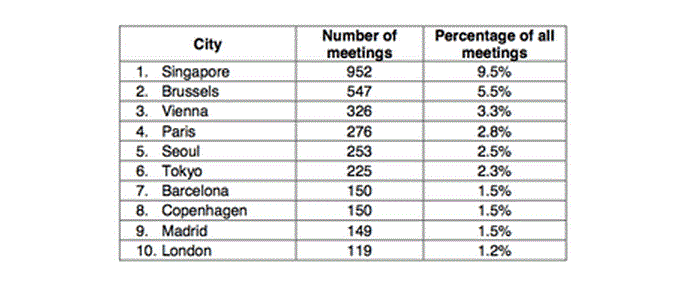
Major events are covered in the press and affect the reputation of the city and the country. The UIA UIA rating ranked countries by the number of events per year (2012 data). In first place is the tiny state of Singapore, which has managed to become the largest event center in Asia. Next are Japan, the USA and Belgium. According to this association, the top 5 event centers are as follows: Paris, Vienna, Barcelona, Berlin, Singapore.
For example, Moscow is in 70th place on this list. Singapore Despite its size, this tiny city-state is rightfully considered the best venue for business events in Asia and the world. Singapore is one of the most developed countries on the planet, which in 30 years has managed to achieve one of the lowest levels of corruption and crime, as well as make an unprecedented leap in economic development, causing sincere admiration among all understanding people.
Singapore hosts the vast majority of the largest Asian and world congresses. In addition, Singapore is famous for its rich nightlife, which is certainly an additional reason to visit it. Among the largest venues is the Singapore Expo - the largest exhibition center in Southeast Asia. The infrastructure of the center includes parking for 2200 cars, and the area of the center itself is more than 100,000 square meters.
Even the hotels here are world attractions (the legendary Marina Bay Sands), not to mention the recently opened futuristic gardens Gardens by the Bay Gardens. As the main characteristic of the winning positioning, we can safely point out the unique infrastructure and quality of service. ICCA Rating ICCA data is also notable for the fact that it has been taken into account for more than 50 years.
The figures show a rapid increase in the number of events since the 60s. Paris "City of Lights" is the record holder for the number of international congresses held. It is the main political, financial and cultural center of France and Europe. The headquarters of UNESCO, the OECD and the International Chamber of Commerce are located in Paris.
Due to the fact that the city is a tourist Mecca, 85% of jobs in Paris are in the service sector. The capital of France is one of the main shopping centers. Event organizers love it for its exquisite charm and aura of romanticism. Despite the strong autoload, Paris is immersed in greenery - this is one of the best examples of respect for the environment.
The main reason for choosing Paris as a venue, of course, is its image, history and opportunities for the informal part of events. Brussels Brussels is the cultural and political center not only of Belgium, but also of the entire European Union, which, of course, gives the city a certain status. It is home to the headquarters of the European Union, the NATO office, and the first world exhibition after World War II.
Another undoubted advantage of Brussels is that thanks to its developed transport structure, it is easily accessible from Amsterdam, London, Paris, Luxembourg or Frankfurt. Hotel prices vary, and each organizer can choose something suitable. In addition, Brussels, with its huge parks, is one of the greenest cities in Europe.
In addition, it is famous for its gastronomic delights and excellent beer. The key characteristic when choosing is transport accessibility within Europe. Vienna Vienna is the third UN resident city after New York and Geneva. It is the cultural, economic and political center of Austria. The Vienna International Center includes the IAEA, UNODC and many other organizations; The city is home to the headquarters of OPEC and OSCE.
It is an ideal place for business meetings due to its convenient location, the highest standard of living and rich history. One of the main advantages of Vienna is its geographical location, which allows you to develop relations with the countries of Eastern Europe. The city boasts a large number of conference centers and nearby hotels for every taste.
The cost of living in a hotel in the center is quite high, but it is possible to choose accommodation and exit: thanks to the excellent public transport system, you can get anywhere in the city in a matter of minutes. The cultural program includes amazing architecture, the famous opera, magnificent gardens and the oldest zoo.
Key characteristics: the city's image and the ability to organize an informal part of the event. Las Vegas Las Vegas is also a great example of creating a successful event center. Everyone knows the city's famous motto: "What was in Vegas stays in Vegas", but the city is successfully promoting another slogan: "Vegas is business".
In addition to sparkling casinos, the city has more than 10 million square feet of exhibition space, most of which is a real work of art. Las Vegas' largest megacities offer an all-under one roof infrastructure, which combines famous nightlife with state-of-the-art event infrastructure: all the best for work and entertainment in one place.
During the day, the most modern equipment, and at night, famous chefs and world-famous shows (for example, Cirque du Soleil). If you add to this the city's advanced infrastructure and beautiful airport, it becomes clear that the city has done everything to become a hub for event organizers. Las Vegas has long been a favorite vacation spot for millions of visitors.
However, in the early 1950s, city and state leaders realized that the cyclical nature of tourism led to a significant decrease in the number of visitors on weekdays, during the summer months, and during the Christmas season. A new market – the event market – was identified to attract more visitors to the area during periods of downturn.
Baku Recently, the leadership of Azerbaijan and Baku has taken a number of steps in the development of the country and the city as an attractive place for organizing events. In 2013, the Ministry of Culture and Tourism announced that it would soon launch its own convention bureau (AzCB) to strengthen the position of the country and the city in the field of MICE and event organization.
AzCB is an example of a partnership between the state and private business, the Ministry of Culture and Tourism and the largest market players. The new structure will position the country and the capital as a unique venue for events that unite Europe and Asia. Istanbul It is worth noting that another city is very well positioned - Istanbul.
The Istanbul Convention and Visitors Bureau offers many options for holding events not only at modern venues, but also at unique venues with a history. They can be found in the "Unusual Sites" section. For example, the Yerebatan Cistern is a huge underground reservoir in the center of the city from the times of Constantinople.
Or the Esma Sultan Yalısı Mansion, a historic three-story brick building on the shores of the Bosphorus. The ruins, consisting only of external walls, were acquired in the early 1990s by the Marmara hotel chain. After restoration with extensions designed by architect Gohan Avcioglu, the mansion was opened in 2001 as a multifunctional facility.
Together with the brick façade, left in its original form, steel and glass structures coexist. How can a city become an ideal place for events? Based on the above ratings and experience in organizing events in different parts of the world, we can give some recommendations to future event hubs. 1. Choosing positioning. You need to bet on 2-3 key characteristics that will be decisive when choosing a venue.
It will be ultra-modern infrastructure (Singapore, Las Vegas) or opportunities for cultural life (Vienna, Paris), or entertainment opportunities (Las Vegas). 2. Infrastructure. The city should have an "infrastructural minimum": a modern airport, a convenient transport system, hotels of various levels, and service in the field of events.
The ease of obtaining an entry permit for foreigners, especially the visa regime, can also be attributed to this moment. Singapore is unique in this regard, which has developed a very flexible visa system for foreigners arriving for several days. 3. Needless to say, all of the above cities can boast of well-functioning service bureaus that are supported by the city and help foreign companies find a site, find partners for organization and plan the entire event. 4.
Opportunities for the entertainment part of the event. Any business event involves an informal part - whether it is an evening program or excursions. The presence of such an additional bonus in the city is an undoubted plus. In short, this point can be defined as follows: whether the city offers something that can only be seen in it. 5.
General economic and social factors. For example, the level of corruption, security, the development of medicine, and the environmental situation. The experience of Singapore shows that it is possible to create the largest event center in a fairly short period of time. If we return to the future of Astana, some of the conditions have already been met, some of them will have to be implemented.
Perhaps the main challenge for the city in the near future will be the development of the service part, the creation of a "smart" infrastructure for event organizers from all over the world.