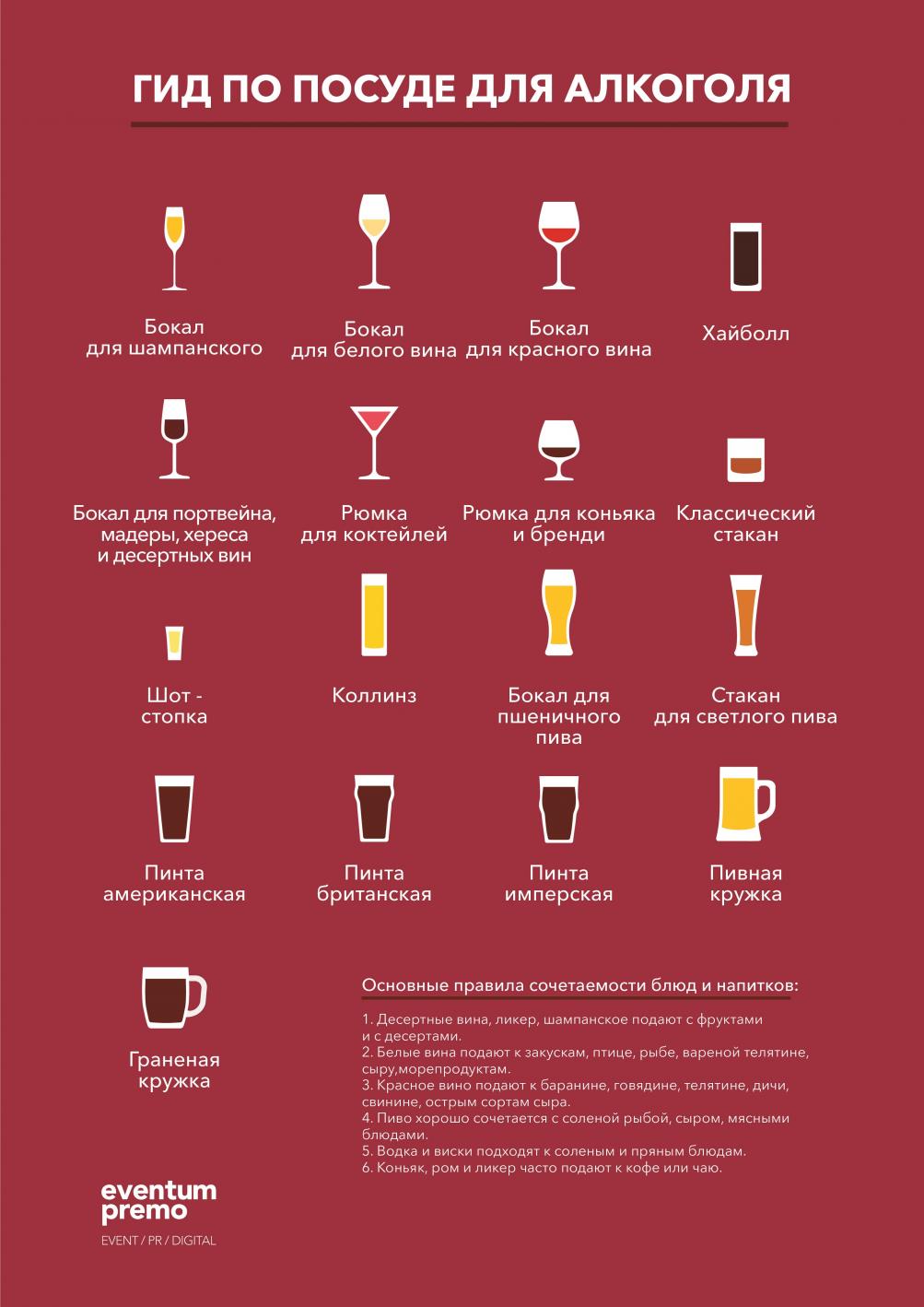
Let's educate ourselves, remember and not confuse.
Champagne glass
This shape of a champagne glass is due to the fact that the bubbles rising from the bottom look very beautiful if the glass is tall enough and small in diameter.
It is better not to use goblets as champagne glasses. Champagne does not play in them and quickly loses its aroma. Champagne glasses should be shaped like a cone, widening gradually upward and then tapering slightly ("Flute" shape). They are made of colorless glass with smooth walls.
White wine glass
White wine is considered less rich than red. White wine glasses are somewhat smaller and do not have a narrow neck, which is simply not necessary. The normal volume of glassware for drinking white wine is 100 milliliters. This is the norm and the most common volume. In some cases, glasses are made in a more elongated shape than for red drinks.
Red wine glass
Red wine is richer in flavor, so it is important to try to retain as much of its evaporation as possible. Glasses for red wine are large in size, but at the same time they have a slightly narrowed neck, which does not allow phenols to escape too quickly. Moreover, this design makes it possible to collect all the wine aroma into a single whole.
Important
Everyone wonders why wine glasses have different shapes? It's all about our tongue, which is a set of taste buds: we feel sweetness with the tip of the tongue, bitterness with the back of it, maximum acidity can be felt on the sides of the tongue, but salty taste is felt the same everywhere.
That is why it is very important which zone of the tongue a particular substance hits. And it is the shape of the glass, its edge, thickness and other factors that determine which point the wine will come into contact with first, which in turn will determine the perception of the wine as a whole. Thus, a correctly selected glass will emphasize the taste and aroma of wine, while the wrong one will, on the contrary, kill it. Of course, the taste of the wine will remain low, only its perception will change.
When planning to use wine glasses, pay attention to them:
- shape (it should be as wide as possible);
- volume (red wines require larger sizes);
- wall thickness (thin crystal or glass is always better);
- processing the rim (it should be perfectly smooth, without thickening);
- design (clean, transparent).
The best companies producing wine glasses: Riedel (Austria), Spiegelau (Germany), L’Atelier du Vin (France), Rona (Slovakia), Zafferano (Italy), Nachtmann (Germany) and Bohemia (Czech Republic, Bohemian glass glasses).
Highball
First of all, this is a universal glass that is used for both alcoholic and non-alcoholic cocktails. This glass is also ideal for various soft drinks, soda, juices or mineral water, which is why it is so indispensable.
Glass for port, sherry, Madeira and dessert wines
To avoid excessive acidity and astringency, we advise you to give preference to glasses that are not very round. The tapered edges of the glass allow the port to be fully balanced so that the full fruit bouquet of this drink can be felt.
Interesting fact: the port wine glass was designed by the famous Portuguese architect Alvaro Siza Vieira for the Douro and Port Wine Institute.
Cocktail glass
This type of glass first appeared in 1925 in Paris. This type of glass is not intended for undiluted (pure) drinks, but exclusively for cocktails, mostly alcoholic ones. It is customary to serve a cocktail glass chilled, first pouring frappe ice into it, or leaving it in the refrigerator for a while. As a rule, such famous cocktails as Vodka Martini, Aviation, Dry Martini, Alexander and others are served in a cocktail glass.
Glass for cognac and brandy
It is also called the Snifter glass. "Sniff" translated from English means "sniff". Therefore, the upper part of the glass has a large diameter and allows you to maximize the aroma of the drink. The shape of the glass and the particularly thin glass allow you to comfortably hold the glass in your hands while heating it. Thus, the drink releases its unique aroma faster.
Classic glass
Typically a glass vessel, similar in shape to a cylinder or truncated cone, without a handle. Suitable for cold and hot drinks. In the latter case, a cup holder is often used.
Shot stack
A shot glass is a type of small glass, the volume of which can be from 50 to 100 ml. There are different types of stacks, but the classic one is considered to be a stack that has a straight cylindrical (sometimes conical) shape with a thick bottom.
As a rule, a shot glass is used to serve strong (necessarily pure) alcoholic drinks: vodka, rum, tequila, as well as cocktails that are drunk in one gulp (B-52, Hiroshima and many others).
Collins
Collins is a cylindrical, straight-sided glass used for long drinks. The glass got its name from the Tom Collins cocktail. The shape of the glass differs little from a highball. Collins is a little taller and narrower.
Wheat beer glass
These stylish, long glasses made from thin glass perfectly convey the color scheme of the drink and have plenty of space for the signature wheat fluffy and dense foam. Most are made in 0.5 liter batches. Advantages: Specially designed for large volumes of beer and foam, and retains the aromas inherent in this beer.
Glass for light beer
This is usually a tall, narrow, wedge-shaped, horn-shaped glass with a capacity of 0.36 liters. Brings out the sparkle and color of the beer while maintaining foam. Benefits: Shows color, transparency, sparkling. Enhances aroma.
American pint
The American pint glass model is recognizable by its shape - a ring thickening at the top of the glass. This thickening performs three functions at once: it improves grip, protects the glasses from “sticking” in the stack and protects the edges of the glass from chipping. The glass is suitable for basic styles of beer of moderate strength.
British pint
Another variation of the pint glass is the British pint or tulip pint. This glass widens slightly from the middle - its top is slightly wider than the bottom. It is in this form that branded Guinness glasses are produced.
Imperial pint
An imperial pint holds just over half a liter. Sometimes this glass is also called “Nonik”. The raised rim at the top of the glass helps prevent chipping and cracking. Traditionally, ales are served in these glasses.
Beer mug
Everything is clear here
Faceted mug
The same as a beer mug, but it looks more solid due to its facets.
But do not forget that excessive alcohol consumption is harmful to your health. And knowing the correct use of different glasses will improve your communication with caterers and allow your event guests to truly enjoy their drinks.
https://event.ru/details/klassifikatsiya-stekla-gid-po-posude-dlya-alkogolya/