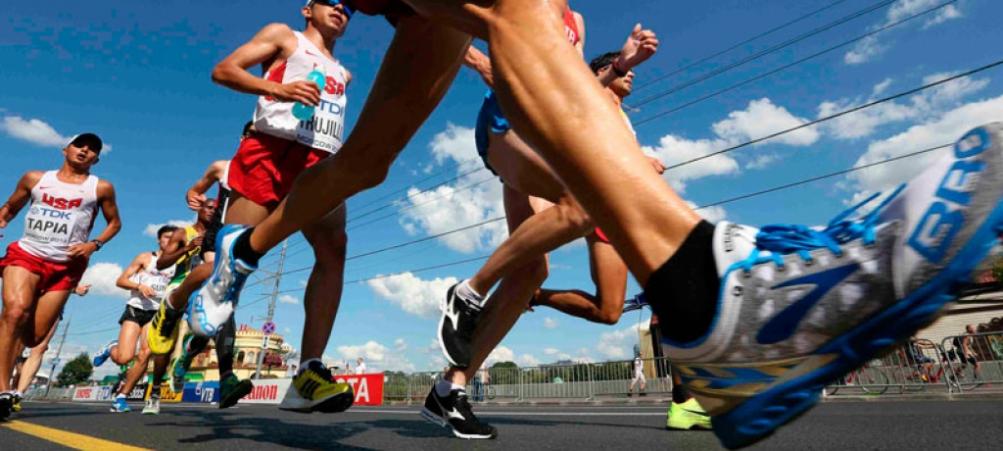
About 2,000 people took part in the corporate 5K, which began in Orlando in 1995. This year, organizers expect nearly 16,000 people to take part in the event, running or walking.
Nearly 16,000 runners are expected to take part in the IOA Corporate 5K Thursday night in downtown Orlando, making the road race the largest in Central Florida. Produced by Track Shack Events, attendance at this event has been steadily growing and sponsored since it began in 1995. The Insurance Office of America has been a sponsor of the event since its inception, and last fall they signed a three-year title sponsorship agreement.
Around the country, many major races are sponsored by large corporations, such as The Bank of America Chicago Marathon and The ING New York City Marathon. “When ING sponsors a race, data shows that the target audience is much more interested in partnering with ING than when ING is not a sponsor,” says ING’s website.
Track Shack Events co-owner Ion Hughes organizes (or advises on) over 40 races across the country. We talked to him about the popularity of the sport and why it is so attractive to corporate sponsors.
According to Running USA, 518,000 people took part in marathons and 1.6 million in half marathons last year. And this is compared to 353,000 and 482,000 in 2000, respectively. How can you explain this growth?
The boom in running and race walking continues. This is the cheapest form of exercise and recreation for people, so such activities continue to grow despite the crisis. There has been phenomenal growth in marathons and half marathons. The IOA Corporate 5K has seen a doubling of participants in the last three years. We are also seeing a steady increase in sponsorships. Thus, it is expected that this year the (total) amount of sponsored funds will increase by 10% compared to last year and amount to $80,000.
Tell us about the people who take part in such events.
Previously, races were held for “tough nuts.” Now it's just the opposite. There will still be professional runners to compete with, but these days they only make up a small percentage. What happens in reality is that people run more for the sake of participation, travel and fun. There are so many events to choose from. People used to do it as a one-time thing, but now it's part of the runner culture - the culture of running, traveling and relaxing. People use races as an excuse to go see new places, and do so several times a year. Another interesting phenomenon is that back in the 1970s it was 85% men and 15% women. Nowadays, half marathons are sometimes run by 60% of women and 40% of men. On the consumer side, this is not bad.
Are there any particular industries that are more likely to sponsor a race?
Medicine is a huge industry, one of the largest. On a national scale, we've seen car companies getting involved. And, of course, manufacturers of sports shoes, clothing and drinks. As well as financial institutions, banks and insurance companies. And sometimes even companies that I would never have thought of, like Lasik surgery. It all depends on the company itself and its marketing plan.
What makes such events attractive to sponsors?
Good demographic statistics. A large proportion of participants are college graduates. Their household income is over $100,000, and even in single-earner families, income can exceed $75,000. They use credit cards, go to restaurants and fly on planes. And this is a very loyal group. You've heard about the loyalty of Nascar fans. I dare say the runners could be second in this ranking. They value people who promote sports and they realize that they need sponsors for such events. And what's great is that a sponsor can become a local, regional and sometimes even international hit.
How do sponsors interact with participants?
When sponsors are fully immersed in the event, they are seen during the preparation, at the event itself and after it. Technology has become useful in that organizers now use social media, email, etc. quite a lot to send out messages about the event. At the same time, the sponsor is also announced several times. For a major event, there is an expo before the event starts where the runner receives their package so the sponsor has the added opportunity to give out their samples or swag. A flyer can be included in a runner's pack and we can also send messages to runners' friends and families on their mobile devices letting them know how their runners are doing and this can also be sponsored. And then post the posts, and that’s the re-mailing. So sponsors have many opportunities to interact with participants.
The original article was published in electronic version BizBash