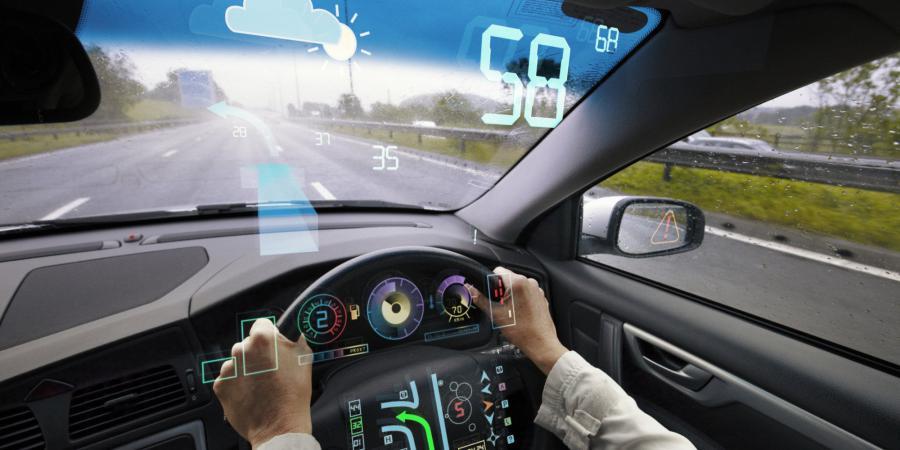
What awaits us in the near future.
There are different views on what the future holds for us. In general, they can be divided into three groups
- Mayan calendar, comet, apocalypse, hana.
- Global crisis, war, savagery, dark times
- One way or another - further progress.
I like option 3, of course. In recent days I've been thinking about how driving cars will change in the coming years. Not when cars start flying on an anti-gravity field, but in the next 5-10 years. Small logical changes. I think that over time we will face a number of mandatory design changes in cars.
For example, there will be mandatory, pre-installed GPS devices and a mandatory GSM SIM card (or something like that) with a unique number, such as a mobile phone.
Now, when you drive with a navigator, it politely informs you that you are breaking the rules by exceeding the speed limit. A GPS device monitors the speed of movement via satellite, overlays it on a map and “sees” that there is a violation. In the future, at this moment, my own GSM card, hardwired deep into the car, will send an SMS to the traffic police saying that I am a violator. And if I turned onto another road and violated it again, another sms about the fine.
A driver's license (DR) will be similar to a credit card - with a chip and all that. And it will be impossible to start the car without inserting the chip. It will be possible to put money on the VU. And fines, as well as travel on toll roads (determined by the GPS device + SMS to the road operator) will be debited from the account in the background. Immediately. When the money for the driver's license reaches a certain limit, the car cannot be started. You will need to ask a friend to come, insert your card and drive the car home.
Using this GSM number, each machine can be found and disabled remotely. True, the traffic police will be responsible for this, so it will become much more difficult to steal cars. Police stations will be located throughout the city in the form of small boxes at traffic lights that send requests to passing cars and process responses - where who is sitting and driving. And the data will be analyzed in streaming mode. If any accident occurs, the driver and the car will be easy to identify.
The car now is a very mechanical device, to which more and more are starting to be added from the computer. I think that soon there will be much more of this second, computer part. Buying a car will be much more like buying an iPhone. You will have a certain account to which you “link” your new car. The account is linked to a credit card and you can purchase many software options separately for your car. “Setting up” the car will be a fun experience and will be done via a smartphone. For example, select a car horn and alarm sounds. Set the default option to automatically turn on the lights and fold the mirrors. Warm up the car from 6.45 to 7.00 in the morning on weekdays. Report empty tank when fuel drops to 10%, 20% or 16.5%. Notify when tire pressure drops to 2000. Disable dynamic driving mode. Traffic jams on your favorite route. Settings for your favorite radio stations (not only on the air, but also on the Internet - for example, Radio Jazz London, Internet broadcasting), setting up video channels for passengers in the rear seats. Which VU have the right to start this car. If some kind of breakdown occurs in the car, a notification appears on the smartphone screen indicating that it needs to be repaired.
There will be special applications for cars in the AppStore and AndroidMarket, which will allow you to save fuel, battery life, or, conversely, drive more dynamically. It will be possible to buy navigation maps, etc. Social networks for motorists.
You can set up your friends’ car numbers, enter them into your contact list, and see them on the screen if someone is nearby.
Organizations buying a car will have something like admin rights and will set available routes. For example, for all kinds of delivery services. And the GPS will monitor whether the driver made a 300-meter detour to buy cigarettes. And so that he doesn’t drive home for lunch and doesn’t “bomb” in the evenings.
To solve the problem of traffic jams, time spent in the car will need to be purchased. There will be different tariffs, as now for cellular communications - unlimited, office tariff, emergency tariff for 1 day. Weekend rate - free on weekends and expensive hours on weekdays.
Or the government will be able to limit the time when you can drive a car. For example, even numbers drive on even days, but on odd days the car does not start. Or, you buy two cars or use public transport half the time. Or you agree with a friend to take turns driving each other to work, “dropping off” along the way.
In general, everything is fine, but there will be hackers who will try to hack it all. OK. Stationary traffic police posts will not check for speeding, but for the correct operation of the software. You are driving along the Moscow Ring Road and suddenly you see a signal light up - stop at the nearest traffic police post. Where a local programmer will check to see if my GPS, VU, etc. have been hacked. Didn't stop - chase with flashing lights and all that.
Such a totalitarian future awaits us. It seems to me that it is almost inevitable, because it is logical. All the technologies already exist; we need to connect them together. And all that is needed is the will and administrative efforts to coordinate the joint work of automakers, mobile operators, banks, mapping services, etc. At first, many things will be voluntary and simply convenient - such as setting up using a smartphone. And then some things will become mandatory. First, in small countries, all cars will be required to install GPS/GSM modules. On new machines they will be pre-installed, on old ones they will need to be installed, like a “black box” on airplanes. Then there will be more and more such countries. Then - rights in the form of a chip card. Sberbank will advertise its convenient tariffs and “loan programs for absent-minded drivers”, VTB will advertise its own.
And then the times of recklessness on the roads will be remembered as the times of sheriffs in the Wild West.